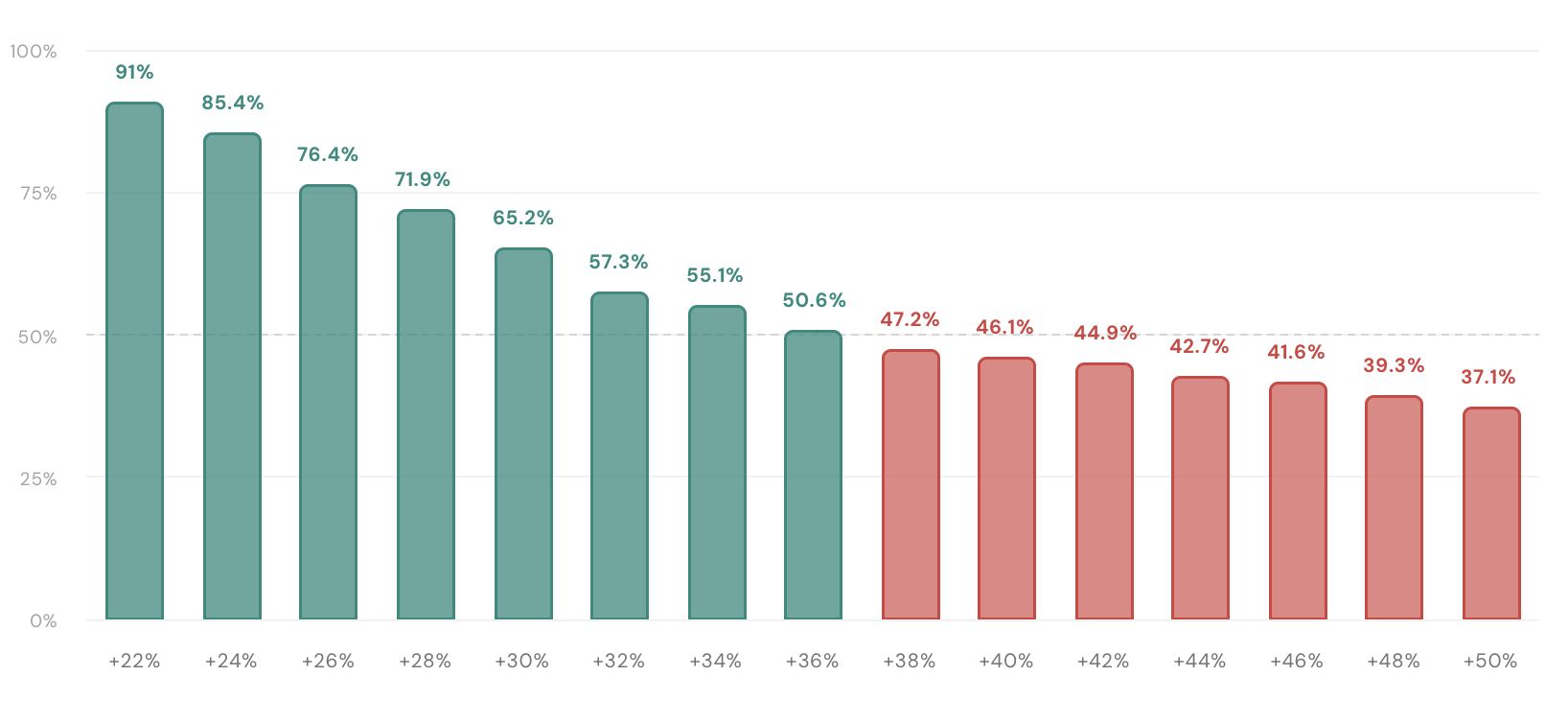
Pick a vol or inverse ETF, set a starting and a target spike level. The Spike Probability Ladder reports how often a cycle that hits the start has actually climbed to the target before a new all-time low resets it, plus how many days that move usually takes.
Volatility ETFs like UVXY, VXX, and SQQQ don't trend. They run in episodic spike cycles. Each cycle starts at a fresh all-time low, climbs some unknown distance as fear hits the market, and ends when a new all-time low prints and the next cycle begins. The decision-relevant question for anyone trading these names is conditional: my ticker has already spiked +20% off its ATL. What are the odds the same cycle keeps climbing to +50% before it resets?
Eyeballing it from a chart is a coin flip. The honest answer needs a bar-by-bar walk of every cycle in the ticker's history, separated by ATL prints, with each cycle's peak measured against the ATL it was anchored to. That's the Spike Probability Ladder.
Pick a ticker from the 15-ETF universe (UVXY, UVIX, VXX, SQQQ, SOXS, ZSL, BOIL up front; DUST, FAZ, GLL, LABD, SCO, SPXU, TSLQ, TZA in the More dropdown). Set From Spike % (the starting threshold a cycle has already crossed, e.g. +20%). Set To Spike % (the target, e.g. +50%). The tool reports back five numbers and a chart.
The headline reading is the probability with both numerator and denominator visible. 61.2% (49/80) means: across the entire history, 80 cycles printed at +20%, and 49 of them carried on to +50% before the next ATL reset. That's a real conditional probability, not a hand-wave.
Below the probability you see four day-counts: median days from the From hit to the To hit (typical pace), average (mean, tail-skewed), shortest (the fastest cycle ever recorded), and longest (the slowest). Anything beyond longest hasn't happened historically.
Below the cards: a distribution chart showing every cycle plotted by days-to-target, and an expandable event log listing each From hit by date, with the ATL it was anchored to, and whether it reached the target.
Six readings off one chosen ticker and one From → To pair. Run it on a different ticker by clicking another pill; run it on a different range by stepping the inputs.
From → To probability shown with the underlying counts: 61.2% (49/80). The denominator is every From-hit cycle in history; the numerator is cycles that also hit To before the next ATL reset.
How long the From → To climb actually takes. Median is the typical pace; average is mean (tail-skewed); shortest and longest are the floor and ceiling of the dataset. Anything beyond longest has never happened.
The clock resets every time the ticker prints a new all-time low. From and To percentages are measured off the running ATL, so the probability is genuinely conditional on this cycle, not on some arbitrary lookback window.
Every reaching cycle plotted by how many days it took to climb from From to To. Shows whether the average is dominated by a few outlier slow climbs or sits inside a tight cluster of fast spikes.
Click to expand a flat table of every From hit in the ticker's history: date, price at the hit, the ATL it was anchored to, and whether the cycle reached To (and how many days it took if so). Useful for spotting regime drift.
UVXY, UVIX, VXX, SQQQ, SOXS, ZSL, BOIL up front. DUST, FAZ, GLL, LABD, SCO, SPXU, TSLQ, TZA in the More dropdown. The full set of leveraged shorts and inverse vol products that move in episodic ATL-anchored spike cycles.
The simulation runs as a single bar-by-bar walk over the chosen ticker's full daily history.
Say UVXY just hit a new all-time low at $5.00. Three weeks later it spikes to $6.00 (+20% off ATL), and fromHit fires for this cycle. Two weeks after that it climbs to $7.50 (+50% off the same ATL), and toHit fires. The cycle gets added to the dataset as a 14-day reach. If instead UVXY had printed a new ATL at $4.80 before reaching $7.50, the cycle would close as a non-reaching event, and a fresh cycle anchored to $4.80 would begin.
This is the tool to open mid-spike, when you're holding a position or thinking about entering one and want to know whether the move you're betting on has historical precedent or is asking the ticker to do something it has rarely done.
Five workflows that lean on the cycle-conditional probability + days-to-target stats.
You're long UVXY and it's spiked +30% off its recent ATL. From=30, To=50 reads back at, say, 38% (24/63). Better than a coin flip, but not great. Now check From=30, To=40. If it's 70%+, that's where the realistic exit lives. Use the ladder to find your honest target.
You want to short the spike but the ticker has only reached +20%. Run From=20, To=50. If that's a 50% probability, you're sizing into a coin flip on continuation. Either tighten the stop, wait for a higher From, or accept the risk. The probability + days-to-target tell you what you're actually trading.
If the median From → To climb takes 12 days, an option short 7 DTE is in a different timing risk than a 30 DTE position. The median + longest stats let you match contract duration to the typical move's pace, not your gut.
Run the same From / To pair across UVXY, UVIX, VXX, SQQQ, SOXS, ZSL, BOIL one ticker at a time. The probabilities differ: UVXY (1.5x VIX) and UVIX (2x VIX) cycle differently than the inverse-equity products. Pick the product whose conditional profile fits the trade you want.
A 60% probability on 8 cycles is noise. The same probability on 80 cycles is signal. Open the per-event log to see how the From-hit count was built and whether the recent few years look anything like the older history. Regime drift hides in the dates.
The Spike Probability Ladder is in your dashboard under Volatility Tools. CI Volatility members can adjust both From and To steppers; free users see the default UVXY 20% → 50% read.
Open the Spike Probability Ladder
Comments
Loading comments…