Moving averages are probably the most discussed strategy in all of trading. Buy when price crosses above the 200-day. Buy when the 50 crosses the 200. Simple, elegant, and repeated in every trading book ever written.
But does it actually work?
We rebuilt the Moving Average Backtester to test this question the way a real trader would. You pick your MA entry signal — either Price Cross or Golden Cross — and the tool finds the historically best profit target and stop loss to pair with it. 2,116 TP/SL combinations tested per MA. The exits aren't guessed; they're optimized.
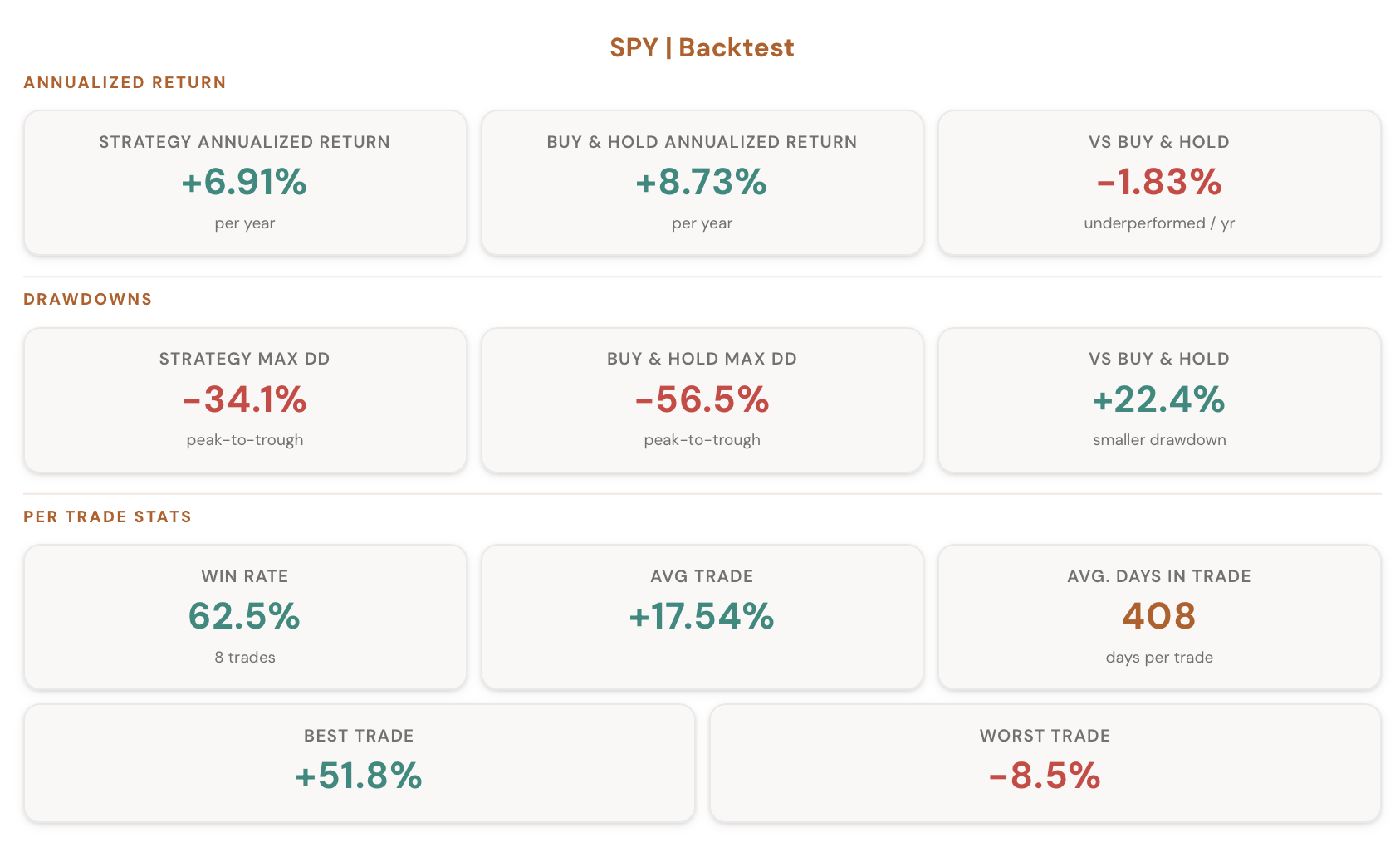
After running it on dozens of tickers, we noticed something consistent: even with the historically optimal profit target and stop loss, moving averages almost never beat buy and hold on total return.
The Challenge
Find a stock where a moving average entry plus the optimal TP/SL beats buy and hold on annualized return. Any ticker. Any MA from 2 to 200. Price Cross or Golden Cross. Click Find Best Combination for Selected MA and the tool does the optimization for you.
Open the Moving Average Backtester, set your MA, click the button, and see if the "vs Buy & Hold" card turns green.
We'll wait.
Why Buy & Hold Is So Hard to Beat
For a ticker with a persistent long-term uptrend — SPY, QQQ, AAPL, MSFT, NVDA — buy and hold captures every dollar of appreciation with zero transaction overhead. Every time you exit a position, even with a 10% or 15% profit locked in, you give up the rest of that trend. And every time you wait for an MA signal to re-enter, you miss days or weeks of participation.
The math is brutal. Over 20 years, SPY has compounded at roughly 9% annually. To beat that with a trading strategy, you need your stops to cut more downside than your targets give up upside — and then you need to re-enter at the right moments. Most MA entry signals don't time those reentries well enough to overcome the trend participation lost on every exit.
So Why Do People Use Moving Averages?
Because total return isn't the only thing that matters.
Look at the drawdown comparison. A 5% stop loss caps individual-trade pain at a known level. The strategy's worst peak-to-trough drop is almost always smaller than buy and hold's worst crash — sometimes dramatically smaller. If you're someone who panic-sells at -20%, the drawdown reduction alone might justify the strategy even if annualized return is lower.
That's the honest trade-off. On a trending stock, moving averages aren't return enhancers. They're sleep enhancers.
The Exceptions
There are tickers where MA strategies actually win. They share one characteristic: they don't have a persistent upward trend.
Commodities, leveraged and inverse vol ETFs, currencies, and instruments that cycle rather than compound are where trend-following earns its keep. If a ticker spends half its time going up and half going down with roughly equal magnitude, an MA entry that catches the uptrends combined with a tight stop that cuts the downtrends can genuinely outperform holding through the full cycle.
Try it. Type in a commodity ETF or a vol ETF. The "vs Buy & Hold" card looks very different from SPY.
Where Does That Leave You?
If you're using moving averages on a stock that has a strong long-term uptrend, you're giving up return to reduce risk. That can be a valid choice. The tool now shows you the exact cost with the exact exits you'd actually use — profit target, stop loss, not some arbitrary MA-based exit that gives back all the gains.
If you're using moving averages on something that doesn't trend persistently upward, you might actually have an edge. Click Find Best Combination for Selected MA and the tool will tell you exactly which profit target and stop loss would have captured it.
Comments
Loading comments…