New Tool Launch
April 1, 2026

VIX Behaves Differently. Now It Has Its Own Tool.

Level frequency, resolution times, futures correlation, and term structure analysis powered by 36+ years of VIX data.

Every tool on CI Volatility was built around the same core idea: leveraged and inverse ETFs grind toward all-time lows through structural decay, and the interesting question is what happens when they spike away from that floor. The spike/decay framework works because products like UVXY, SQQQ, and SOXS are designed to lose value over time.

VIX doesn't work that way. It's mean-reverting, not perpetually decaying. It doesn't create new all-time lows every few months. It oscillates between regimes, spending long stretches below 20, then snapping above 30 during stress events before settling back down. The framework that explains UVXY's behavior doesn't map cleanly onto VIX itself.

That distinction matters. When VIX hits 25, the question isn't whether it's going to decay back to some structural floor. The question is: how often does VIX reach this level, how long does it typically stay here, and what does the futures curve look like when it does?

Those are fundamentally different questions, and they deserve a dedicated tool.

Introducing the VIX Deep Dive Tool
VIX Deep Dive tool showing level frequency analysis across 36 years of data

The VIX Deep Dive is built specifically for the VIX. It pulls from over 36 years of daily VIX data, combined with real-time VIX futures prices, to give you a complete picture of where VIX is, where it's been, and what typically happens next.

Each tab answers a different layer of the same fundamental question: is the current VIX level unusual, and what does history suggest about where it goes from here?

What the Tool Shows You

Four tabs, each designed to answer a different dimension of VIX behavior.

Level Frequency

How Often VIX Reaches Each Level

See how many times VIX has hit 15, 20, 25, 30, 40, 50, 60, and 80. View the average frequency, percentage of days at or above each level, and average days per year.

Resolution Time

How Long Spikes Last

Once VIX crosses above a level, how many trading days does it typically take to resolve back below? Broken down by entry level and exit level.

Custom Levels

Set Your Own Thresholds

Don't just use the preset levels. Enter any custom VIX level and get the same full analysis, whether you want to check VIX 18 or VIX 45.

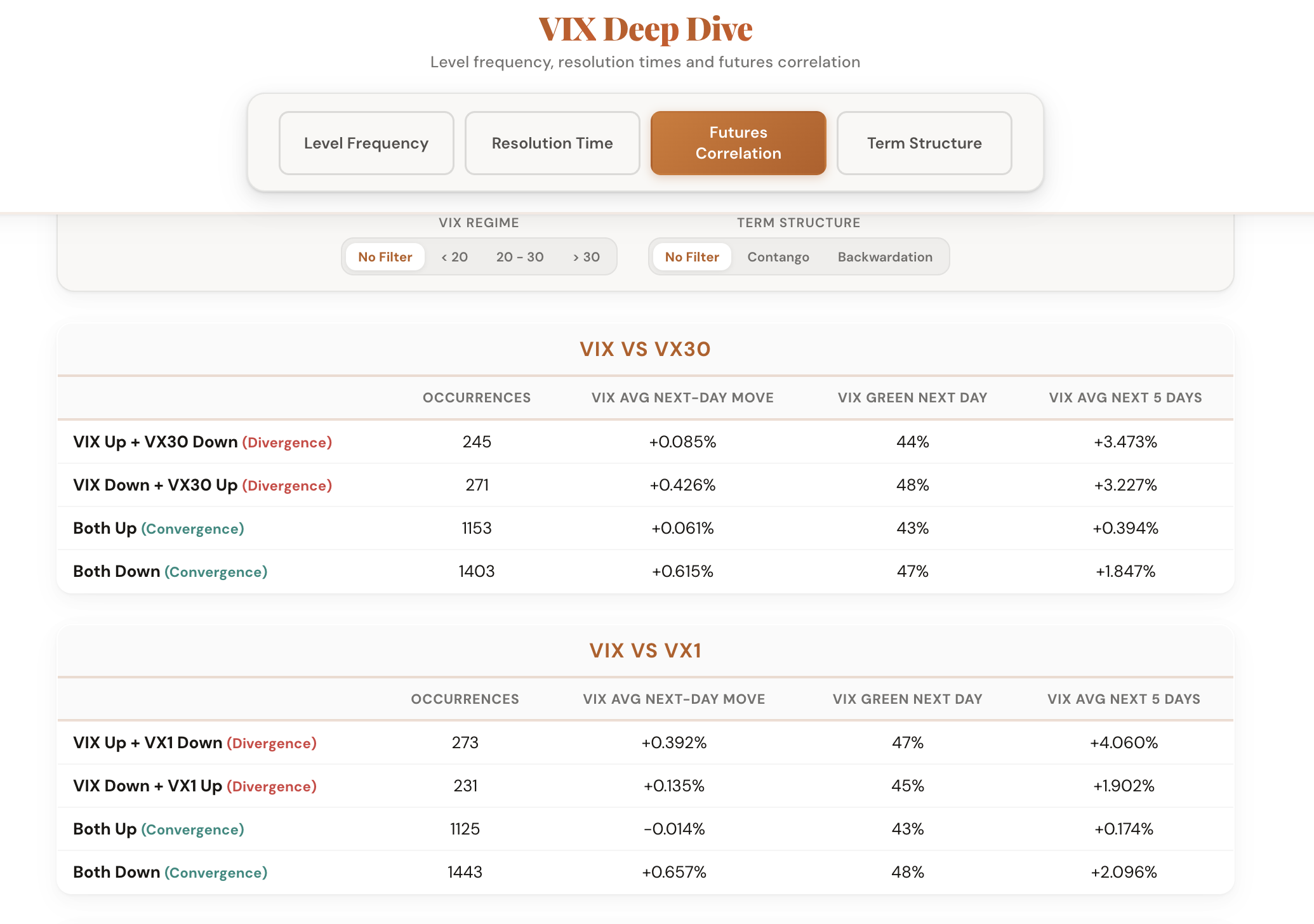
Futures Correlation

Spot vs. Futures Divergence

When VIX spikes but VX30 doesn't follow, what happens next? This tab breaks down convergence and divergence patterns between spot VIX and VX1, VX2, and VX30.

Term Structure

Contango and Backwardation

How often is the VIX curve in contango vs. backwardation? What does each regime imply for VIX over the next day and next 5 days?

Filtering

VIX Regime Filters

Slice all analysis by VIX regime. See how patterns change when VIX is below 20, between 20 and 30, or above 30. Context changes everything.

Why VIX Needed a Separate Tool

Most VIX analysis online falls into one of two categories: either a live chart with a moving average, or a vague statement that VIX is "elevated" or "subdued." Neither tells you much about what to actually expect.

The problem is that VIX levels carry very different weight depending on context. VIX at 25 during a slow grind higher feels different than VIX at 25 during a sharp spike from 15. And VIX at 25 with the futures curve in steep contango tells a different story than VIX at 25 with the curve flat or inverted.

The VIX Deep Dive was built to surface exactly this kind of context. Instead of relying on feel or anecdote, you can check:

How Traders Are Using It

Five ways members are already applying the VIX Deep Dive to their process.

1

Gauging spike severity

VIX just hit 30. Is that a once-a-year event or something that happens every few months? The Level Frequency tab puts the current reading in historical context instantly.

2

Timing entries after a spike

Use the Resolution Time tab to understand how long VIX typically stays above a given level. If the median resolution from VIX 30 is 8 days, you know whether you're early or late.

3

Reading the term structure

Check whether VIX is in contango or backwardation and what that has historically implied for the next 1 and 5 trading days. The Term Structure tab lays it out clearly.

4

Spotting divergence signals

When VIX spikes but futures don't follow, or vice versa, the Futures Correlation tab shows you whether that divergence historically led to mean reversion or continuation.

5

Regime-aware analysis

Every tab supports VIX regime filtering. See how patterns shift when you isolate low-vol environments vs. crisis periods. The same level can mean very different things depending on context.

The Tool Is Live Now

The VIX Deep Dive is available in your dashboard under Premium Tools. If you're a CI Volatility member, you already have access.

Open the VIX Deep Dive

Comments

Loading comments…