Every 0DTE options seller has the same fear: the market moves too far, too fast, and your short option goes in the money. You sold a put 1% below SPX and it drops 1.5% by 3pm. It happens. But how often?
That's the question the Probability Lab was built to answer.
Why Every 0DTE SPX Trader Needs This
Same-day expiration options on SPX are the fastest-growing segment of the options market. You sell a put or call in the morning, and by 4pm it either expires worthless or you're taking a loss. There's no rolling to next week, no hoping for a reversal tomorrow. The only thing that matters is today's move.
Open the Probability Lab, select SPX, and set the threshold to 5%. The tool instantly shows you what percentage of all trading days had a move of 5% or more in either direction. If only 2% of days move that much, your short option has a 98% chance of surviving the day. That's your edge, quantified.
Selling Puts: Know Your Downside Frequency
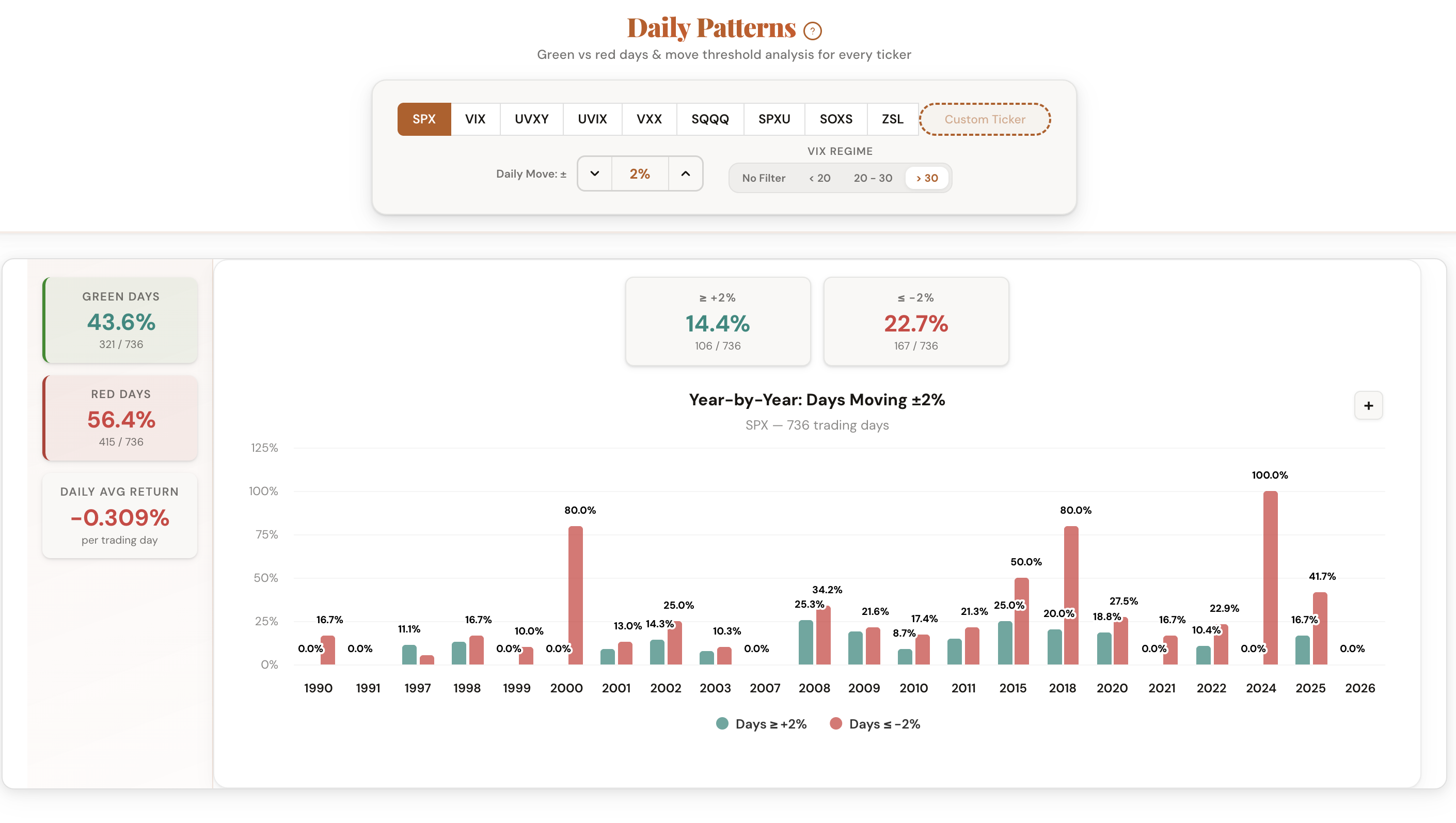
Suppose you sell a 0DTE SPX put at a strike 1% below the current price every morning. Before you make this a daily routine, open Probability Lab and set the threshold to 1%.
Now add the VIX regime filter. Set it to "> 30" to see how the odds change when volatility is elevated. High-VIX environments produce larger daily moves, which means your put is more likely to go in the money. The filter quantifies this shift so you can adjust your strike distance or skip the trade entirely.
Selling Calls: Know Your Upside Risk
The same logic works in reverse. Selling 0DTE SPX calls above the market? Set the threshold to match the distance between the current price and your call strike. The tool shows how often SPX rallies that much in a single session.
SPX doesn't move symmetrically. Down days tend to be sharper than up days. The Probability Lab lets you see the green vs red day breakdown separately, so you can set tighter call strikes and wider put strikes if the data supports it.
The VIX Filter Changes the Game
Daily move frequencies are not constant. They shift dramatically with the VIX level. SPX might breach 1% on 15% of days in a calm market, but 40% of days when VIX is above 30.
The VIX regime filter lets you isolate exactly this. Before selling your 0DTE, check the current VIX level and filter the Probability Lab data accordingly.
Works Beyond SPX
While 0DTE SPX is the primary use case, the same approach works with any stock or ETF that has same-day expirations. TSLA, AMZN, AAPL, QQQ, IWM all have daily options. Run them through Probability Lab with your strike distance as the threshold and you'll know the historical odds before you sell.
Comments
Loading comments…